AI Curation as Craft: The Emerging Curatorial Practice of Generative Art
Why Curation Gains New Relevance in the Age of AI
The rapid rise of generative systems has transformed the artistic landscape. Images can now be produced in seconds, at a scale previously unimaginable. Yet this acceleration does not create meaning. It creates noise. In this environment, curation becomes more than a supporting discipline—it becomes a cultural necessity. AI art requires a new form of curatorial intelligence, one capable of distinguishing artistic intention from algorithmic output. As the field expands, the curator becomes the figure who provides orientation, coherence, and critical depth. This shift marks the beginning of a new curatorial era.
unimaginable. Yet this acceleration does not create meaning. It creates noise. In this environment, curation becomes more than a supporting discipline—it becomes a cultural necessity. AI art requires a new form of curatorial intelligence, one capable of distinguishing artistic intention from algorithmic output. As the field expands, the curator becomes the figure who provides orientation, coherence, and critical depth. This shift marks the beginning of a new curatorial era.The Core Challenge: Reading Patterns, Revealing Meaning
Generative systems operate through pattern recognition. They identify structures, probabilities, and visual relationships. But patterns alone do not constitute art. Art emerges when a human being introduces intention, direction, and emotional resonance. The role of the AI curator is to bridge these two domains: to understand the logic of the system while recognizing the depth of the artist. This requires a dual literacy—technological and aesthetic. The curator must see beyond the surface of the image and identify where human authorship becomes visible within algorithmic complexity.
Curatorial Criteria in the AI Era: Intention, Coherence, Resonance
Traditional criteria of artistic evaluation remain relevant, but they shift in emphasis when applied to generative art. Three dimensions become central:
– Intention — the conceptual and emotional direction guiding the work.
– Coherence — the presence of a recognizable artistic signature across variations.
– Resonance — the ability of a work to create a moment of connection with the viewer.
These criteria allow curators to differentiate between mere output and genuine artistic expression. In the work of Konrad Wulfmeier, for
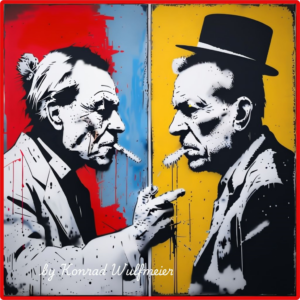
example, intention becomes visible through mythological depth, structural clarity, and a consistent aesthetic language that extends across series and systems. The curator’s task is to make these qualities legible.
The Practice of AI Curation: Selection, Context, Interpretation
Curation in the context of AI art is not simply about choosing images. It is a multi‑layered practice that involves:
– Analyzing generative systems — understanding parameters, models, and algorithmic behavior.
– Identifying artistic signatures — recognizing recurring motifs, structural decisions, and conceptual frameworks.
– Contextualizing works — placing them within art‑historical, technological, and cultural narratives.
– Translating complexity — making the process and meaning accessible to diverse audiences.
This practice requires sensitivity, expertise, and the ability to navigate between human and machine. It is not a technical role, but a curatorial one—rooted in interpretation, judgment, and cultural responsibility.
Institutional Relevance: Why Museums and Galleries Need AI Curators
Institutions worldwide are beginning to integrate generative art into their programs, yet many lack the frameworks to evaluate or present it effectively. They face questions such as:
– How do we exhibit AI‑generated works?
– How do we communicate their creation process?
– How do we assess artistic value?
– How do we distinguish authorship from automation?
This is where the AI curator becomes indispensable. The presence of Konrad Wulfmeier’s works in the Leonardo da Vinci Museum and the HNF—the world’s largest computer museum—demonstrates that generative art is already entering institutional spaces. These exhibitions signal a growing recognition that AI art is not a technological novelty but a cultural development requiring professional curatorial guidance.
The Artist’s Signature in the System: Why Intention Remains Irreplaceable
A common misconception is that AI “creates” the artwork. In reality, generative systems do not possess intention, memory, or emotional experience. They cannot originate meaning. They can only generate patterns. The artist remains the source of direction, narrative, and conceptual depth. The AI curator’s role is to identify where this human presence becomes visible within the system. In Wulfmeier’s work, this presence is unmistakable: a mythological architecture, a systemic aesthetic, and a resonance that cannot be produced by the machine alone. Curation protects this intention from being diluted by the vastness of algorithmic output.
Outlook: The Future of Curatorial Practice
AI curation is still in its early stages, but its importance will grow rapidly. As generative art becomes more prevalent, institutions will require new exhibition formats, new interpretive strategies, and new criteria for collecting. The AI curator will stand at the center of this evolution—not as a technician, but as a cultural mediator. The future of art will be hybrid, shaped by the interplay of human intention and machine capability. Curation will be the discipline that ensures this interplay remains meaningful, coherent, and culturally grounded.