The New Curatorial Era of AI Art
A Turning Point in the Art World
The art world is entering a historical transition. Generative systems are not simply new tools; they are catalysts that reshape how art is created, perceived, and valued. This shift is subtle yet profound—comparable to the early days of photography or video art, when new technologies challenged established definitions of artistic authorship. Today, we stand at a similar threshold. The convergence of human intention and algorithmic structure is opening a new artistic field that fascinates institutions, galleries, and collectors while simultaneously confronting them with unfamiliar questions. The issue is no longer whether AI art matters, but how we understand it—and how we curate it responsibly.
created, perceived, and valued. This shift is subtle yet profound—comparable to the early days of photography or video art, when new technologies challenged established definitions of artistic authorship. Today, we stand at a similar threshold. The convergence of human intention and algorithmic structure is opening a new artistic field that fascinates institutions, galleries, and collectors while simultaneously confronting them with unfamiliar questions. The issue is no longer whether AI art matters, but how we understand it—and how we curate it responsibly.Generative Art as a Dialogue Between Intention and Algorithm
Generative art emerges from the interplay of two forces: human intention and machine pattern formation. The artist contributes presence, experience, aesthetic direction, and inner necessity. The machine contributes speed, variation, and the ability to reveal complex structures. Together, they create works that are neither purely technical nor purely intuitive. They are hybrid forms—visual, conceptual, and emotional spaces that did not exist before. This is where curation begins: identifying which works carry meaning, which reveal a recognizable artistic signature, and how human depth becomes visible within algorithmic structures.
Why Curation Becomes Essential in the Age of AI
As generative systems become widely accessible, the volume of images grows exponentially. But quantity does not create quality. Galleries and institutions now face the challenge of distinguishing between mere variation and genuine artistic expression. Curation becomes a key competence because it provides orientation. It filters, contextualizes, and reveals what is relevant. A curatorial eye recognizes intention, coherence, aesthetic logic, and the capacity of a work to generate resonance. In the age of AI, curation is not simply selection—it is a form of responsibility toward the artwork, the audience, and the cultural ecosystem.
Originality and Value in AI Art
The question of originality is central to collectors and institutions. In generative art, originality does not arise from technical uniqueness but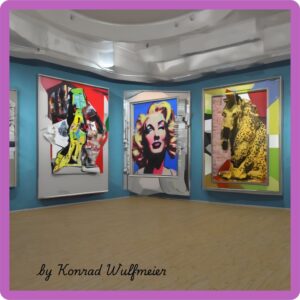 from the combination of human intention, system architecture, and curatorial selection. A work gains value when it carries a clear artistic signature, when it belongs to a coherent series, and when it resonates with viewers. Institutions are beginning to recognize this. Works by Konrad Wulfmeier have been shown in the Leonardo da Vinci Museum and the HNF—the world’s largest computer museum—demonstrating that generative art is already entering institutional spaces. Value emerges where art is not merely produced, but understood.
from the combination of human intention, system architecture, and curatorial selection. A work gains value when it carries a clear artistic signature, when it belongs to a coherent series, and when it resonates with viewers. Institutions are beginning to recognize this. Works by Konrad Wulfmeier have been shown in the Leonardo da Vinci Museum and the HNF—the world’s largest computer museum—demonstrating that generative art is already entering institutional spaces. Value emerges where art is not merely produced, but understood.Institutions in Transition: Navigating an Expanding Field
Museums and galleries must now integrate generative art into their existing frameworks. This requires new forms of presentation, new interpretive strategies, and new criteria for evaluation. Institutions that respond early gain a cultural advantage: they position themselves as places that not only preserve history but also shape the future. The parallels to the rise of video art are clear. Initially misunderstood, video art eventually became a central part of museum practice. Today, generative art follows a similar trajectory—only faster, more global, and more technologically complex. Curation becomes the bridge between tradition and innovation.
The Role of the AI Curator: From Patterns to Meaning
The AI curator is not a technician but a mediator between human intention and machine output. This role involves identifying which patterns carry meaning, which works reveal a consistent artistic voice, and how generative systems can be used aesthetically and conceptually. The AI curator contextualizes works, protects artistic intention from algorithmic randomness, and ensures that generative art is understood not as a technical novelty but as a cultural practice. The future of art depends on this mediation. Without curation, generative art risks being misread; with curation, it becomes a new chapter in art history.
Outlook: The Future of Generative Art
The development of AI art is only beginning. Yet the direction is clear: collaboration between artists and systems will expand the definition of creativity. Galleries and institutions that understand this shift will develop new forms of exhibition, new methods of interpretation, and new ways of collecting. The role of the curator will remain central—as a guide, a translator, and a guardian of meaning. The new era of art is not a break from the past but an expansion of it. It connects intention and algorithm, tradition and innovation, pattern and meaning. And it opens a space in which art is not only created, but redefined.